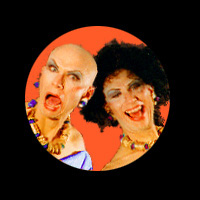
DUAL DIVAS represent my first significant foray into... well, let's call it "travesty." I don't think what I've done here is remotely worthy of the term drag, given the artistry, craft and rigor that goes into a true drag creation. After all, what upright drag queen would tack together some old drapes and call it a dress? Or dream of stepping before her public without the tastefully coordinated pair of back-strap spike sandals? Or put on play-doh jewelry and even think herself accessorized? Or give so little thought to the proper foundation garments?
I started out planning just one character, someone I thought of as the Bald Prima Donna. The idea was to make a tribute to the opera diva and the classic gestures employed in grand tradition operatic acting, but -- to give it a little edge, a certain German expressionist something -- to do it with a shaved head. But shortly before shooting, I started wondering if I were trying to avoid the level of gender switching that putting on a wig would provide. So I dug my Captain Hook wig out of the attic and attempted to give it a little upsweep. Once I had on my makeup, press-on nails and false eyelashes I found that rather different characters were emerging depending on whether I had the wig on or off. Bald, I felt exalted, dramatic, a very serious artist. Bewigged, I felt showy, glitzy, ready with a wisecrack, a real mistress of ceremonies.
So I realized I could be two divas rather than one. Dual Divas. Dueling Divas. From the day of George Frederic Handel down to the famous Maria Callas/Renata Tebaldi feud of the 1950s, rivalries between prima donnas have been a part of operatic gossip and lore. Often the rivalry is based in a perceived contrast in aesthetics and temperament. In his book on the history and art of the prima donna, Demented, Ethan Morrden uses a fictitious character, Lotte Heinotz, to introduce the concept of two basic kinds of diva, the Stimmdiva and the Kunstdiva. Briefly, the Stimmdiva (voice diva) places beautiful tone production, pure musicality, and virtuosa technique at the apogee of her art, while the Kunstdiva (art diva) puts voice and musicianship at the service of emotional expression and characterization. The distinction is useful, whether you're thinking of female opera singers (Joan Sutherland: Stimmdiva; Renata Scotto: Kunstdiva) or male pop singers (Nat "King" Cole: Stimmdiva; Frank Sinatra: Kunstdiva). Here, I think of the bald one as the Kunstdiva, her gestures highly influenced all the incredible still pictures of Maria Callas, the ultimate Kunstdiva. The bewigged diva may not exactly be a Stimmdiva -- but she's definitely a crossover queen, the kind of opera singer who sings it all, wows you with a high note, and gets her own variety show in Germany: Anna Moffo with a touch of Edie Gormé.
In a rare act of manipulation, to create a little added contrast between these two ladies, I colorized their gowns on the computer.
I particularly loved being the bald diva. While the idea of public crossdressing had never really appealed to me, I definitely thought it would be fun to show up at a party in this guise. Will they admit me at Wigstock without a wig?
Images created September 2, 1998

Amused, amazed, appalled?
Insights, ideas, invective?
E-MAIL
the Chameleon