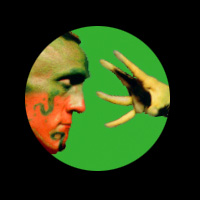
GREEN BERDACHE is an example of a character that I didn't fully envision in advance and didn't grasp until I was in front of the camera. Further, until I saw the pictures myself, I didn't completely comprehend what I was expressing. All I had to start with was a strong idea for a few elements that I knew I wanted to bring together.
Chief among those elements was the mohawk haircut -- peak point of my week of shaving my head back -- and the desire to use it in a context that had the look of an aboriginal society. Second was my urge to pose in a big skirt. I had imagined a big brocade skirt of many panels that I'd make out of heavy drape material. The effect I was after wasn't exactly feminine: I liked the idea of my bare torso rising out of big, dense swathes of fabric that might drag on the ground in a big train. I thought of the magisterial effect of the big skirts that the heroes and demons wear in in Katha Kali. Being short on the time it would take to build such an ambitious costume, I devised an alternative that I could fashion in a few hours: the skirt is constructed out of several colors of textured window display paper that I had acquired for a project some 15 years earlier.
Finally, I wanted to create a make-up design that would go with the partial baldness and draw on some of my Internet browsing at tattoo and body-mod sites, as well as inspirations including Maori chin tattoos and photos I'd seen of fashion models with a single color of makeup halfway down their faces. I knew I wanted swirly patterns on the body.
Making up was slow and focussed; I started the process late in the evening, somewhat fatigued from a busy day. These factors put me into a kind of altered state of consciousness, and it was very early morning before I got in front of the camera. I felt a kind of contemplative calm and comfort in this guise that I allowed to rule my poses.
I didn't name the character "Green Berdache" until I looked at the photos and wanted to identify the combination of masculine and feminine expression that I saw in the images. The berdache is a figure common in many Native American societies. Generally they are male-born people who have assumed some dimensions of a female role in their society. Rather than being reviled for this destiny, as they would be in most postindustrial Western societies, berdaches are accorded honor and sometimes looked upon as spiritually gifted, or as mystical bridges between the worlds of male and female. Similar phenomena are documented in many societies beyond the American continents. Recently queer people, particularly transgendered people, have been taking inspiration from these individuals and the status they have in their communities. The berdache illuminates an understanding of gender that transcends sex roles sharply dichotomized and strictly assigned by anatomy. (It bears saying that the term "berdache" is a European one with a derogatory origin. Native American tribal languages have their own names for these people; a common one translates as "two spirit.")
This character is not intended to express the history or anthropology of the berdache or to resemble any society's version of the berdache. He is a manifestation of my own androgyny, of my conviction that my natural gender expression falls between the extremes of masculine and feminine, and of a spiritual peace and affirmation that I assert in that expression.
I don't claim it for myself, but I'm inspired by the fire and fierceness of that famous drag-queen retort to the would-be basher: "I'm more woman than you'll ever have and more man than you'll ever be."
Images Created: August 29, 1997

Amused, amazed, appalled?
Insights, ideas, invective?
E-MAIL
the Chameleon