The Gas Ball Problem
Problem
Suppose there is a big ball of gas, the size of a large planet, out in space.
Assuming it's standard Earth air, it should have enough mass to produce a sizeable
gravitational field. Is that gravity enough to hold the ball together, or will the
gas expand and dissipate? How big would it have to be to have standard Earth
pressure at its center? How big would it be if it had the same mass as the Earth?
Conditions
Uniform temperature (25 C), ordinary air with spherical symmetry
Steady state - no swirling or expanding (but stability is another question)
Standard Earth pressure at center (10^5 Pascals) or Earth mass (5.98 * 10^24 kg)
Equations
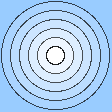 The gas ball can be viewed as a series of thin, spherical shells of gas around a common
center.
Pressure, density, and gravitational acceleration are constant on the surface of a shell,
but these quantities differ between shells of different radius.
At steady state, on a shell of radius ri, the pressure of the gas depends on the weight of
the gas from all of the shells outside of it:
The gas ball can be viewed as a series of thin, spherical shells of gas around a common
center.
Pressure, density, and gravitational acceleration are constant on the surface of a shell,
but these quantities differ between shells of different radius.
At steady state, on a shell of radius ri, the pressure of the gas depends on the weight of
the gas from all of the shells outside of it:
p(ri) = Integral, with respect to r from ri to infinity, of d(r)·g(r)
| where | d(r) | = density of gas at radius r |
| | = p(r) / ( R·(10^3 / z) · absolute temperature) |
| R | = universal gas constant |
| | = 8.314 J/mol-K |
| z | = average atomic weight of air |
| | = 28.8 amu |
| g(r) | = gravitational acceleration at radius r |
| | = G · mass within shell / r^2 |
| G | = universal gravitational constant |
| | = 6.672 · 10^-11 (in MKS units) |
The gravitational acceleration acting on the gas in a shell of radius ri depends on the mass
of the gas in all of the shells inside of it; this mass depends on the density of the gas:
m(ri) = Integral, with respect to r from 0 to ri, of d(r) · 4 pi r^2
Differential Equations
The two equations above that include integrals can be cast as differential equations:
| pressure: |
dp
dr |
= |
-p
k·T |
· |
Gm
r^2 |
= |
-7.75e-16 |
· |
p·m
r^2 |
| mass: |
dm
dr |
= |
_p_
k·T |
· |
4 pi r^2 |
= |
1.46e-4 |
· |
p·r^2 |
Two differential equations require two boundary conditions for a particular solution. To answer the question of how big the gas ball would be if the center had standard Earth pressure, the initial pressure and mass should be set accordingly:
| p(r=0) |
= |
1.01·10^5 Pascals |
| m(r=0) |
= |
0 kg |
To determine how big the gas ball would be if it had the same mass as Earth, the following conditions are needed:
| m(r=0) |
= |
0 kg |
| m(r=infinity) |
= |
5.98·10^24 kg |
This latter condition (r=infinity) is hard to meet. It may be necessary to transform
the independent variable r into another variable with a finite range.
Numerical Solution
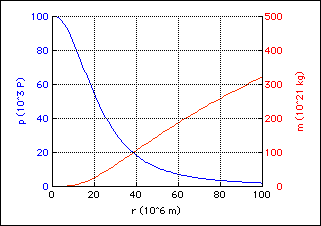 A fourth-order Runge-Kutta method was sufficient to solve these equations given the
initial conditions at r=0. For the case of atmospheric pressure at center
(p(0)=1.01*10^5 P, m(0)=0 kg), the equations were integrated from r=0 to 10^8 m over
100 steps; using 200 steps (i.e., half the step size), the result changed by less than
1 part in 10^4. So, the result shown here should be accurate.
A fourth-order Runge-Kutta method was sufficient to solve these equations given the
initial conditions at r=0. For the case of atmospheric pressure at center
(p(0)=1.01*10^5 P, m(0)=0 kg), the equations were integrated from r=0 to 10^8 m over
100 steps; using 200 steps (i.e., half the step size), the result changed by less than
1 part in 10^4. So, the result shown here should be accurate.
How big is this ball of gas? Well, the pressure drops off to about 2% of its initial value
at 10^8 meters from the center, but it does so so smoothly, it may never reach zero.
So, there is no distinct outer boundary, and designating any particular radius as one
would be arbitrary. Nevertheless, choosing 10%
initial pressure, the outer boundary is 5.235 * 10^7 m, or about 8 times Earth radius.
The gas inside this radius has a mass of 1.581 * 10^23 kg, or about 1/40 Earth mass.
However, the mass of the gas outside this radius may well be infinite, as the graph
shows the mass function steadily increasing at 10^8 m.
How big is the gas ball if it has the same mass as Earth? Once again, the choice of
outer boundary is arbitrary, but let's use 10% initial pressure. The equation's
boundary conditions become m(0)=0 and m(r such that p(r) = p(0)/10)=5.98*10^24 kg.
However, knowing the radius at which p(r) = p(0)/10 requires having solved the equations.
Instead, many guesses of p(0) were used to solve the equations until one was
found that met the outer boundary condition. Actually, only a few guesses were needed,
as a simple scaling rule quickly became apparent: given one solution with initial
conditions p(0)=p1 and m(0)=0, a new solution with p(0)=p1/100 and m(0)=0 yields
pressures 100 times less and masses 10 times more, but both are stretched out over
10 times the distance. That is, given
| p(0)=p1 | and | m(0)=0 | yield |
p(r) | and | m(r) |
| then |
| p'(0)=p1/100 | and | m'(0)=0 | yield |
p'(r) = p(r/10)/100 | and | m'(r) = m(r/10)*10 |
Additionally, this new solution would reach 10% initial pressure at 10 times further out
than the given solution, and the mass inside that sphere would be 10 times higher.
Since the intended mass of the Earth-heavy gas ball is 37.8 times more massive than
the standard-pressure-at-center gas ball, the 10%-pressure radius should be 37.8 times
5.235*10^7, or 1.98*10^9 m, and the pressure at the center should be 1.01*10^5
divided by 37.8^2, or 70.6 P. It seems strange that a lower initial pressure would
yield a larger gas ball, but then the outer boundary chosen was rather arbitrary, and
a light gas core can't hold more gas around it as tightly as a dense gas core.
Analytical Solution
Since this set of differential equations is non-linear, there might not be any
closed-form solution. Still, inspection of the numerical results should reveal
some clues about the form of the solution.
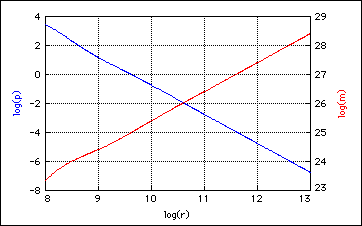 How do pressure and mass change as r goes to infinity? Continuing the integration
out to r = 10^13, p decreasing steadily and mass increasing steadily. In fact, both
functions appear quite linear on a log-log plot as r nears 10^13, and their slopes
indicate fixed powers of r. This suggests p and m have the forms
How do pressure and mass change as r goes to infinity? Continuing the integration
out to r = 10^13, p decreasing steadily and mass increasing steadily. In fact, both
functions appear quite linear on a log-log plot as r nears 10^13, and their slopes
indicate fixed powers of r. This suggests p and m have the forms
Sure enough, when this solution is plugged back into the differential equations,
they fit!
dp
dr | => | -3 c1
r^3 |
and |
k1·p·m
r^2 |
=> |
k1·c1·c2
r^3 |
dm
dr | => | c1 |
and |
k2·p·r^2 |
=> |
k2·c1 |
However, this solution can't match either set of initial conditions because it
says that pressure is infinite at the center of the gasball.